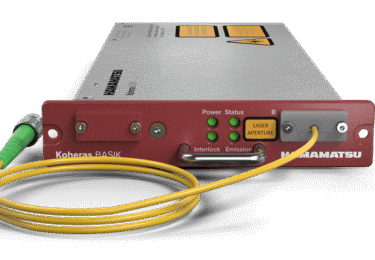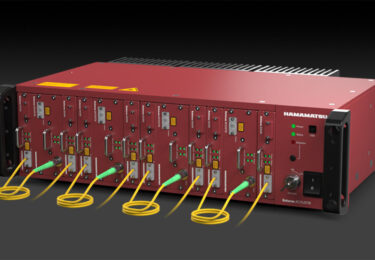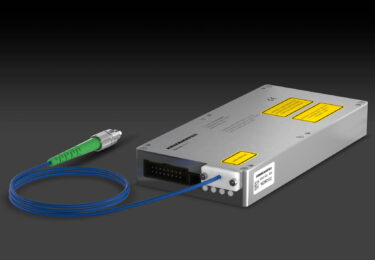
Single-frequency lasers emit light at just one exact wavelength, delivering a clean, coherent beam with ultra-narrow linewidth and outstanding frequency stability. These lasers enable some of the most advanced technologies in quantum computing, metrology, and defense. From controlling individual atoms to performing ultra-precise measurements, they provide the stability and precision that make breakthrough innovations possible.
Low Noise and Ultra-narrow Linewidth
Imagine pressing a single piano key and holding a pure note without any vibration or variation – that’s what a single-frequency fiber laser does with light.
While most lasers emit across a range of wavelengths, single-frequency lasers concentrate on just one, producing a crystal-clear beam with no drift or interference. This ultra-narrow linewidth – often below 1 kHz – enables exceptional spatial and temporal coherence, long coherence lengths, and outstanding frequency stability.
Such spectral purity is made possible by components like fiber Bragg gratings (FBGs), which act as ultra-selective optical filters inside the laser cavity, allowing only a single wavelength to resonate. Many designs also use distributed feedback (DFB) structures and gain media such as erbium, ytterbium, or thulium-doped fiber to maintain the narrow linewidth. These lasers often incorporate polarization-maintaining fibers and advanced stabilization techniques to ensure stable performance, even in challenging environments.
With their robust, all-fiber construction, excellent beam quality, and low noise characteristics, single-frequency fiber lasers are indispensable in precision applications such as interferometry, high-resolution spectroscopy, quantum optics, and coherent LIDAR.
Though their tuning range is limited, they deliver output powers from milliwatts to several watts, making them reliable tools for both scientific and industrial use.
Stability, Precision, Resolution
When your application requires exceptional stability, precision, or resolution, single-frequency lasers offer a level of performance that’s hard to match. With linewidths often in the kilohertz range and exceptionally low phase noise, they can detect even the slightest shifts in frequency, distance, or vibration, making them essential in scientific research, industrial monitoring, and defense systems.
Their long-term stability and resistance to environmental changes set them apart. Whether installed in a vacuum chamber or deployed along a remote pipeline, these lasers remain locked to the same precise wavelength, consistently and reliably, day after day.
Applications Across Industries
Single-frequency fiber lasers are used in a wide range of precision applications where narrow linewidth, low noise, and high stability are critical.
- Quantum Technologies
In quantum computing and cold atom systems, single-frequency lasers are essential for manipulating individual atoms. Different wavelengths are used to trap, cool, and control atomic states, forming qubits, the building blocks of quantum processors. - High-Resolution Spectroscopy
Their narrow linewidth allows for the resolution of fine spectral features, making them ideal for detecting trace gases, studying molecular transitions, or monitoring environmental pollutants. - Interferometry and Metrology
These lasers provide the stable, coherent light needed for high-precision distance and displacement measurements in applications like optical interferometers and optical coherence tomography (OCT). - LIDAR and Doppler Velocimetry
In coherent LIDAR systems, single-frequency lasers enable the detection of phase shifts caused by moving targets, allowing for accurate velocity and range measurements. - Atomic and Molecular Physics
They are used for laser cooling, trapping, and probing atoms, where stable frequency and low noise are essential for interacting with narrow atomic transitions. - Gravitational Wave Detection
Single-frequency lasers serve as the light source in large-scale interferometers like LIGO, where long coherence lengths and low phase noise are crucial for detecting minute spacetime distortions. - Defense and Aerospace
These lasers are deployed in inertial navigation systems and laser gyroscopes, where their robustness and frequency stability ensure reliable performance in challenging environments. - Seeding High-Power Amplifiers
Single-frequency lasers act as seed sources for fiber amplifiers, providing a stable, low-noise signal that can be scaled up in power while maintaining coherence. - Precision Manufacturing and Inspection
They are used in laser-based alignment and inspection tools where high spatial coherence and frequency stability are critical for detecting sub-micron defects and variations. - Distributed Acoustic Sensing (DAS)
Single-frequency lasers are used in DAS systems to send coherent pulses down optical fibers, enabling the detection of acoustic vibrations over long distances for applications like pipeline monitoring, perimeter security, and seismic sensing.
Guaranteed Mode-hop-free Performance for Life
Our Koheras fiber lasers are inherently stable. The key to the low noise is its gain medium and fundamental structure. The high-Q-value fiber Bragg grating ensures stable emission and high-frequency stability. Due to its intrinsic low-noise design, you get sub-picometer stability and mode-hop-free performance throughout the lifetime of the laser.
Built for Demanding Real-world Applications
Since 1998, we have shipped over 20,000 Koheras lasers, valued for their narrow linewidth, high-frequency stability, low noise, and manufacturing scalability. Designed for reliability, our maintenance-free Koheras lasers can operate in extreme environments, such as oil rigs, submarines, wind turbines, and even in space, thanks to the fundamentally robust and reliable laser design.
Our single-frequency lasers are compact, efficient, and ready for the real world. Their fiber-based architecture makes them robust and easy to integrate into existing systems, whether in labs, remote field sites, or space-constrained enclosures. If you’re developing next-generation technologies, single-frequency laser technology offers the accuracy, stability, and reliability to support your work.