
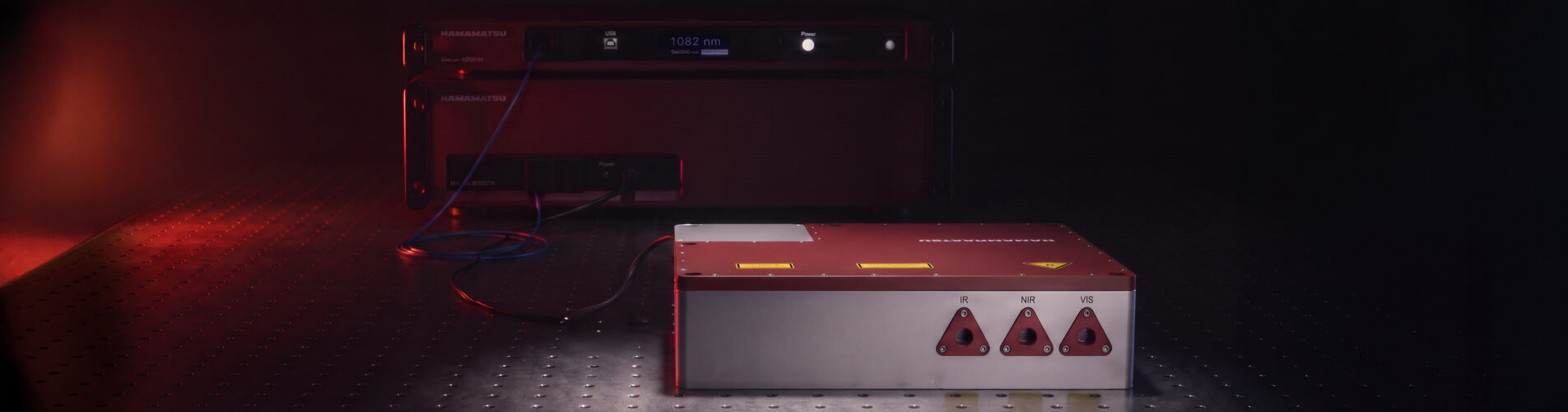
We claim that our Koheras fiber lasers are stable. To prove it, we put them to the test with a national metrology institute.
Are you working in AMO? Is laser phase stability, frequency stability, and low-intensity noise important to you? If so, you would want stability that’s been demonstrated, not just specified.
DFM helped us put that claim on solid ground. As Denmark’s National Metrology Institute, they independently tested two nominally identical Koheras HARMONIK HP H69 systems at 698 nm – looking at frequency/phase stability and intensity noise (RIN).
They did this by comparing the two lasers directly and measuring the heterodyne beat note between them. That approach reveals the pair’s combined relative noise, so the results show how stable the systems are relative to each other.
DFM confirmed that the lasers can be kept stably locked for hours (6 hours in their test), supporting cleaner, more repeatable AMO measurements.
The Laser Platform
At the core of the H69 is a straightforward idea: combine two clean, single-frequency fiber lasers and generate 698 nm through sum-frequency generation (SFG). Each system uses a 1082 nm and a 1970 nm laser, amplified and mixed in the HARMONIK module to produce the final 698 nm output.
For this evaluation, both systems were operated to specification. To make a precise comparison, DFM attenuated the 698 nm outputs and combined them with a photodetector. Roughly 0.30 mW and 0.37 mW reached the detector from the two arms, producing a strong, clean beat signal with high contrast – well suited for low-noise phase and frequency analysis.
Optical Phase-locking Methods
To explore what the platform can deliver under active stabilization, DFM implemented an optical offset phase lock using a Vescent SLICE‑OPL and tested two practical actuator paths:
- Piezo-based Lock – Internal Actuator: First, the phase lock was closed using the built-in piezo actuator on the 1082 nm laser of one system. Because real systems can experience occasional phase excursions, the beat signal was divided before phase detection to reduce the risk of cycle slips and keep the lock robust. In this configuration, the phase lock primarily improves low-frequency noise, as expected for a piezo-based loop.
- AOM-based Lock – External Fast Actuator: Next, DFM added a faster actuator by placing an AOM between the seed and the amplifier. The SLICE‑OPL controlled the AOM drive (with a Moku:Lab acting as a VCO), while a slower loop to the piezo kept the AOM within its tuning range. This approach increases the effective control bandwidth and improves suppression of faster frequency fluctuations.
The report also notes that the VCO chain can add excess noise beyond the plotted measurement range – important context for applications that care about phase noise far from carrier.
To check real-world behavior, DFM also tracked the phase difference over time. The piezo lock remained continuously locked over a 6-hour run, while the AOM-based measurement was intentionally ended after about an hour.
How DFM Measured Performance
DFM used two complementary tools to capture both overall stability (time-domain statistics) and fine spectral detail:
- A Microchip 53100A phase-noise analyzer, used to record phase fluctuations and derive phase noise, frequency noise, and Allan and modified Allan deviation.
- An Agilent 53230A frequency counter, used for high time resolution and for spotting narrow spectral features, with the practical limitation that it approaches its measurement floor at low frequencies under locked conditions.
All instruments were referenced to the same 10 MHz source. For free-running measurements, linear drift was removed before calculating spectra.
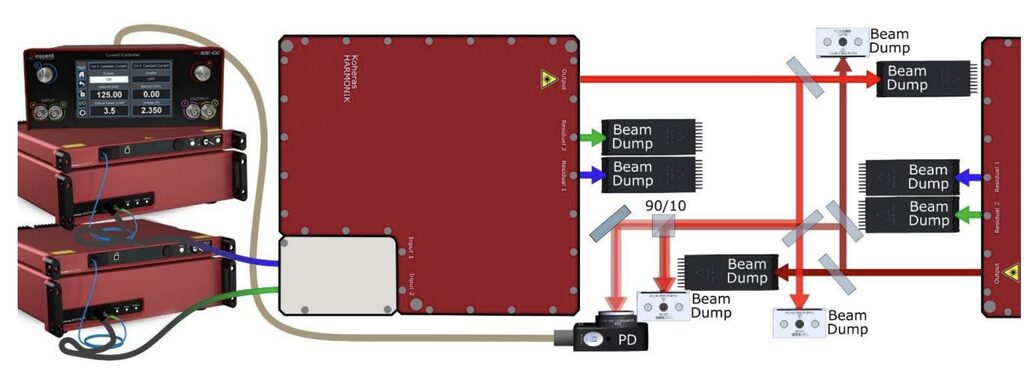
Experimental setup for measuring the relative noise between two nominally identical Koheras HARMONIK HP H69 systems, the right laser system is truncated, as it is a replica of the left system, without the locking feedback. The light used for sum-frequency generation at 1970 nm (blue) and 1082 nm (green) is dumped after sum generation, while the 698 nm light (dark and light red) is attenuated to0.30 mW and 0.37 mW, respectively. (Figure and caption from the report).
Stable Lasers for Cleaner AMO Results
In conclusion, the independently verified performance shows that these lasers can be stabilized to deliver steadier frequency and more consistent output power – helping AMO experiments achieve cleaner spectroscopy, longer coherence times, and more repeatable results.
Want to see what this level of stability could do in your setup? Contact us.